Continuous Environmental Tracking

Image
Fish
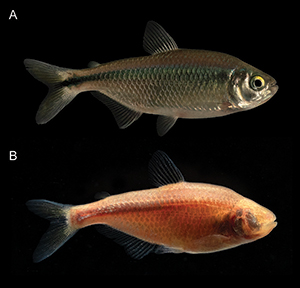
Fig. 1 - Adult stages of Astyanax mexicanus (Mexican tetra).(A) Rascón surface fish with functional visual system and distinct pigmentation.(B) Tinaja cavefish (eyeless) with minimal pigmentation on head and body.Image credit: Macrophotograph by Michael J. Boyle and Michael Lane (From https://www.icr.org/article/15449/)

How do living creatures change and adapt to new and changing environments? That is a question that has been debated by creationists and evolutionists for well over a century. When it comes to the large-scale changes like moving from molecule to man, the two camps hold to irreconcilable positions/answers to that basic question. Special creation and macroevolution (be it the Darwinian version or the “theistic” version) always have been, and continue to be, mutually exclusive. Either God created the original “created kinds” (or baramins) and one never “evolves” into another, or all of life has descended from an initial life-form as a result of major transformations driven by environmental/selective pressure, that is to say “natural selection” acting on random mutations.

That being said, for decades now, creationists and evolutionists alike have agreed on the validity of microevolution, the idea that small-scale changes (within a Biblical “created kind”) can occur naturally via the same process of “natural selection” acting on random mutations. Thus, up until recent times, most creationists would not question the mechanism that theoretically drove the change postulated by neo-Darwinism, just the unlimited extent of the change that was claimed by evolutionists. That is now beginning to change with the introduction of a brand new theory of biological design called “continuous environmental tracking” (CET) that has been proposed by scientists at the Institute for Creation Research (ICR). In contrast to the existing evolutionary paradigm of random mutations and natural selection, CET is engineering-based and non- random/non-mystical in nature. It holds much promise in providing design-based explanations for how creatures change and adapt to their environments. Before examining this new theory in detail, let’s first review and evaluate the old theory about “how creatures change/adapt” that has dominated the scientific literature for nearly a century.

The Discovery and Implications of Orphan Genes

The goal of this paper is to review some significant findings from the analysis of genetic sequence data over the last few decades. These results have surprised many biologists and are believed by many to challenge the key assumptions about how life came to exist on this planet. In particular, these recent findings indicate that the diversity of genetic information across the entire range of life forms is much greater than previously known and that this information in the form of protein-coding genes shows that all forms of life are much more distinct from each other at a very fundamental level than ever was previously understood. These results call into question specific key assumptions that make up the evolutionary explanation for life:

Creation Ministries International’s Recent Superconference at Myrtle Beach

I recently attended the Creation Ministries International (CMI) five-day Creation 2022 Superconference at Myrtle Beach, South Carolina. TASC board members Drs. Jeff Gift and David Greear were also in attendance. The conference was held from May 30 to June 3 at the beautiful Hilton Myrtle Beach Resort, located right on the ocean. There were 597 in attendance from all over the country, 22 lectures, 10 CMI presenters, a massive bookstore, a children’s program, optional opportunities to attend a guided tour through a nearby aquarium with marine biologist Dr. Robert Carter or to match wits with chess master Dr. Jonathan Sarfati, and free time to enjoy the beach.

July Creation conference lecture hall

Fingerprints of the Creator

Our God is infinite in love (1 Jn 4:8), knowledge (Heb 4:13), wisdom, and power (Heb 1:3). He is eternal (Ps 106:48) and not bound by time. He is personal and exists as a Trinity of three Persons: Father, Son, and Holy Spirit. As a person, God has a mind, emotions, and a will. Human beings also have attributes of mind, emotion, and will because we were created by Him in His image (Gen 1:26). We know God became a man who came into the world to rescue sinners who would believe on Him for eternal life. The fingerprints of the God of the Bible are everywhere in His creation. He has left clues of his power and wisdom everywhere. The universe and all that is within it were created by Him and for Him (Col 1:16).

Review of Jonathan Wells’s New Book Zombie Science (Part 2)

Image

Zombie Science book cover
Figure 1

This is Part 2 of a two-part series on Konathan Wells's new book Zombie Science. 1 Wells is a noted intelligent design (ID) advocate and author of the influential book Icons of Evolution. 2 Most of Part 1 was dedicated to reviewing the original Icons. 3  Here in Part 2, several new icons of evolution will be discussed such as whale evolution, the human appendix, human “tails,” “junk” DNA, the “poor” design of the human eye, antibiotic resistance, and cancer. Other topics such as the impact of evolutionary thinking on education, medicine, social mores, human dignity, and science itself will be touched upon. As before, this review will explore the more important points brought out in the book, chapter by chapter. Wells, who has his doctorate in molecular and cell biology, is a good writer with a keen command of his subject. He writes clearly and concisely with penetrating insight and a sense of humor.