Continuous Environmental Tracking
How do living creatures change and adapt to new and changing environments? That is a question that has been debated by creationists and evolutionists for well over a century. When it comes to the large-scale changes like moving from molecule to man, the two camps hold to irreconcilable positions/answers to that basic question. Special creation and macroevolution (be it the Darwinian version or the “theistic” version) always have been, and continue to be, mutually exclusive. Either God created the original “created kinds” (or baramins) and one never “evolves” into another, or all of life has descended from an initial life-form as a result of major transformations driven by environmental/selective pressure, that is to say “natural selection” acting on random mutations.
That being said, for decades now, creationists and evolutionists alike have agreed on the validity of microevolution, the idea that small-scale changes (within a Biblical “created kind”) can occur naturally via the same process of “natural selection” acting on random mutations. Thus, up until recent times, most creationists would not question the mechanism that theoretically drove the change postulated by neo-Darwinism, just the unlimited extent of the change that was claimed by evolutionists. That is now beginning to change with the introduction of a brand new theory of biological design called “continuous environmental tracking” (CET) that has been proposed by scientists at the Institute for Creation Research (ICR). In contrast to the existing evolutionary paradigm of random mutations and natural selection, CET is engineering-based and non- random/non-mystical in nature. It holds much promise in providing design-based explanations for how creatures change and adapt to their environments. Before examining this new theory in detail, let’s first review and evaluate the old theory about “how creatures change/adapt” that has dominated the scientific literature for nearly a century.
The Established Paradigm
If the Darwinian theory of evolution is true and all of life has descended from a common initial ancestor, then there must be some “engine” that drives that change/modification! What is it? Darwin, himself, certainly didn’t know and didn’t really claim to know. He knew nothing of genetics. Mendel was actually doing his famous pea-plant experiments during the same time period that Darwin published On the Origin of Species. Furthermore, Darwin had no idea of the complexity of the cell. For all he knew it was a “blob of protoplasm.” It would not be until the 1930s and 1940s that the neo-Darwinian synthesis emerged and more or less combined Darwin with Mendel. The “engine” that drove evolutionary change was formulated to be “natural selection” (almost personified as if it had volition) “acting on” or “selecting” from random mutations to the genetic code that would be passed on to future generations. Ever since, the term evolution, when used in scientific or popular literature, has generally meant the neo-Darwinian synthesis.
This paradigm has become more and more entrenched into the scientific establishment ever since, to the point that if one questions it in the modern world, one is a scientific “heretic.” Such a heretic has left the world of “science” and entered the world of “religion,” we are told, which is equivalent to the world of Santa Claus, the world of the tooth fairy, etc. Unfortunately, once a theory becomes an “established paradigm” in science, it is almost impossible to dethrone it. Agnostic molecular biologist Michael Denton, writing all the way back in 1986 in his seminal work, Evolution: A Theory in Crisis, explains:
Yet no matter how convincing such disproofs might appear, no matter how contradictory and unreal much of the Darwinian framework might now seem to anyone not committed to its defense, as philosophers of science like Thomas Kuhn and Paul Feyerabend have pointed out, it is impossible to falsify theories by reference to the facts or indeed by any sort of rational or empirical argument. The history of science amply testifies to what Kuhn as termed the “priority of the paradigm” and provides many fascinating examples of the extraordinary lengths to which members of the scientific community will go to defend a theory just as long as it holds sufficient intrinsic appeal. 1
The Evident Problems
Just because a paradigm is “established” does not mean it is true, and it certainly does not mean there are not evident problems associated with it. Creationists have been quick to point out the huge and obvious problems with the neo-Darwinian synthesis. For one, there is a huge and obvious difference between molecules to man evolution and changes in the beak sizes and shapes of finches on the Galapagos Islands! The terms microevolution and macroevolution were invented by evolutionists, probably to try and disguise this huge and obvious difference. After all, logically if you add up a lot of small amounts of change you will eventually get a large amount of change. Right? It does seem logical initially.
Macroevolution is what we typically think of as “Darwinism”—the molecule to man variety of evolution. Creationists and evolutionists have vehemently disagreed on the scientific validity of this idea from Darwin’s day until our own. However, with microevolution it is very different. Most creationists have traditionally accepted the validity of these small-scale changes within “created kinds” primarily because we see them happening all around us on a regular basis (unlike macroevolutionary changes that no human has ever witnessed). However, accepting the one does not logically necessitate accepting the other as creationists have traditionally, and rightly, pointed out! Nor does accepting the reality of small changes within creatures necessitate accepting the “engine” proposed by evolutionists to drive said changes. Consider the following argumentation that I have used for years, myself, in criticizing the idea of macroevolution. I am actually cutting and pasting below right from my own dissertation from back in 2015. 2
The Bible states in these verses that the various plants and animals were only able to reproduce after their own kind. This allows for much variation within a kind (microevolution) but allows for no change of one kind into another (macroevolution or “Darwinism”). For example, today we see many different types and varieties of dogs and cats. However, we see no “dats” or “cogs.” It has long been known that natural selection (i.e., the survival of the fittest) can account for changes within a species. For instance, Darwin himself was influenced greatly by microevolutional changes evidenced in the varieties of finches he observed on the Galapagos Islands. Honest evolutionists, however, will admit that microevolutional changes are irrelevant when it comes to evidence for “molecule-to-man” macroevolution. For instance, Marjorie Grene, a leading philosopher and historian of science at the University of California, Davis, stated,
That the color of moths and snails or the bloom on the castor bean stem are “explained” by mutation and natural selection is very likely; but how from single-celled (and for that matter from inanimate) ancestors there came to be castor beans and moths and snails, and how from these there emerged llamas and hedgehogs and lions and apes—and men—that is a question which neo-Darwinian theory simply leaves unasked. 3
However, if we had enough microevolution wouldn’t that eventually lead to macroevolution? This logic sounds reasonable. As a matter of fact, it is a typical “rescuing device” used by evolutionists in response to the argument that microevolutional changes are not relevant when it comes to arguing for macroevolution. The logic dissipates, however, when one realizes that microevolution is actually going in the wrong direction: the direction of decreased complexity, not increased complexity as is required for macroevolution. The key to increased complexity is new information, not a different selection from existing information. For instance, to go from a microbe to a man you have to add a whole library of new coded genetic information to the genome. It is estimated that a microbe has about two books of five hundred pages worth of coded genetic information, while a human has about one thousand books worth.
Any theory attempting to explain molecule-to-man evolution must explain how the additional information got into the genome. Where did it come from? Let’s assume we have a life form capable of reproduction. Does natural selection provide the new information needed for evolution? Absolutely not! Natural selection merely selects from and conserves what is already there. Both natural and artificial selection actually reduce genetic information. For example, when a dog breeder breeds for long-haired dogs he is using artificial selection to direct a change over time, but this does not represent an increase in genetic information, but a decrease, since the new dogs, when interbred, will no longer be able to have offspring with short hair.
… Therefore, it is misleading at best when the media or the scientific establishment attempt to prove molecules-to-man-evolution by sighting simple examples of microevolution. Former University of California Berkeley law professor Philip Johnson writes, “That one word evolution can mean something so tiny it hardly matters, or so big it explains the whole history of the universe. Keep your baloney detector trained on that word. If it moves, zap it!” 4
If natural selection can’t create more information, what does? The answer typically given is mutations. However, the argument that mutations are the mechanism for evolution is equally void of scientific evidence. Mutations are almost always harmful to the organism, not beneficial. Information theory teaches us that when information is transmitted it either stays the same or gets more random. Illustrations might include randomly changing the letters in a sentence or repeatedly copying an audio tape. The result will be more randomness or noise, not more useful information. Even evolutionists agree that mutations are rarely if ever beneficial. However, they claim that occasionally we see some beneficial ones such as:
- Flightless birds on islands that can swim and dive better.
- Wingless beetles on windy islands that aren’t blown out to sea as easily.
- Eyeless fish in caves (where they couldn’t see even if they had eyes) that are not subject to injuries/infections caused by bumping eyes on rocks.
- Bacteria gaining resistance to antibiotics (This is not referring to the common scenario where some of the bacteria already had resistance, but those rare scenarios in which a mutation produces a defect with a beneficial side effect. In every case studied thus far the bacteria has become less fit to survive overall in a general environment in spite of the beneficial side effect. This example is similar to the genetic disease “sickle-cell anemia” in man which does convey resistance to malaria as a beneficial side effect to an otherwise harmful disease. 5 )
However, on the microbiological level, all of these, according to information scientist and former professor at Johns Hopkins University, Dr. Lee Spetner, turn out to be loses of genetic information. Spetner states, “All point mutations that have been studied on the molecular level turn out to reduce the genetic information and not to increase it.” 6 Creationist biologist Robert Carter adds, “In fact, it looks like all examples of gain-of-function mutations, put in light of the long-term needs of upward evolutionary progress, are exceptions to what is needed, because every example I have seen involves something breaking.” 7
So clearly, creationists have made solid distinctions between microevolution and macroevolution for years and have argued that we likely should not even use these terms because they imply something that is not true—a little bit of change could add up to a lot of change. 8 Thus, I and other creationists have argued for years that macroevolution is bogus! However, what if microevolution is also bogus? That is, in essence, what ICR is arguing with their new engineering-based theory of biological adaption and change.
The Engineering Principles
Unlike the established paradigm that is random and a bit mystical, ICR’s new model is based on tried and tested principles of human engineering. In their own words,
A basic premise of a TOBD (theory of biological design) incorporated into CET is that “the engineering paradigm in modern biology” is fundamental, and, therefore, engineering principles should guide biological research. In terms of adaption, a new concept was proposed; engineering principles underlying how human-designed things self-adjust to changing environments is the most accurate way to explain how organisms adapt themselves. 9
In other words, ICR assumes that if creatures were really designed by God they should exhibit the same sort of tell-tale signs of design that are found in anything and everything designed by human engineers. Since they clearly do, we can also assume that the same sort of mechanisms that human engineers would use to allow their designs to “self-adjust to changing environments” should be found in creatures and should be included in any theory of biological adaption.
This past fall I personally had the privilege of joining ICR’s “Parks Across America” tour of South Florida. While on the trip a couple of the ICR scientists, including the president, Dr. Randy Guliuzza, presented lectures about CET during some evening sessions. As a former engineering student (BSEE from West Virginia University, 1988) these presentations fascinated me! “Dr. G” explained in his talks more about the engineering principles involved with CET. He explained that for creatures to adapt they needed three things—sensors, logic, and output. Compare this to a self-driving automobile designed by human engineers. They need sensors to sense speed, approaching vehicles, etc. They need a computer to make calculations based on the input from the sensors, and they need output to be able to adjust things like speed, direction, etc. In like manner there is more and more evidence that all creatures are designed with such sensors, logic, and output; and coded information (in the DNA) is already there to turn various genes on and off based on the input received from the sensors. This is called “epigenetics” and further dispels the “junk DNA” myth of earlier days! Much of the so called “junk” that doesn’t code for genes regulates when and how often genes are turned on or off. ICR’s theory is that creatures are continuously tracking changes in their environment and adapting accordingly according to preprogramed design!
The Epigenetic Patterns
To support their new theory, ICR scientists site example after example of creatures that are able to rapidly and repeatedly change and adapt to similar environmental “pressures.” One famous example the evolutionists used to use to show an example of a “beneficial mutation” and natural selection leading to adaption was the Mexican fish, Astyanax mexicanus, which has both a normal variety and a blind variety that has also lost pigmentation. ICR marine biologist, Dr. Michael Boyle, had a session specifically on these fish during the south Florida tour I was on. The blind variety of these fish are always found in cave environments, deep underground without light.
Image
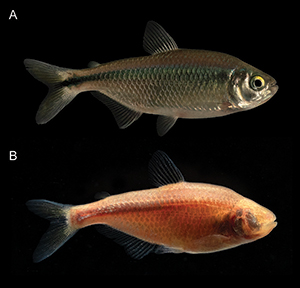
Adult stages of Astyanax mexicanus (Mexican tetra).
(A) Rascón surface fish with functional visual system and distinct pigmentation.
(B) Tinaja cavefish (eyeless) with minimal pigmentation on head and body.
Image credit: Macrophotograph by Michael J. Boyle and Michael Lane (From https://www.icr.org/article/15449/)
The traditional argument was that a mutation caused the fish to lose the ability to make eyes and this was an advantage in a context where sight was impossible anyway, and natural selection “selected” the blind variety in these environments. However, ICR’s research is finding that this supposedly random adaption has happened repeatedly in isolated populations (that have no contact with one another) all over northeastern Mexico. Furthermore, they show evidence for many other creatures, particularly insects, that also lost eyes and pigment in similar environments. Also, the fish aren’t just losing eyes, the eyeless cavefish variety are also exhibiting specific and identical adaptations that compensate for the absence of vision such as enhancements in feeding, smell, respiration, energy storage, and metabolism, navigation, etc. See here for further details: https://www.icr.org/article/15449/. Furthermore, ICR’s experiments have shown that pigmentation can be restored in succeeding generations from exposing the cave variety to light. In other words, the changes are not only rapid and repeatable, but they seem to be reversible! Several other examples were cited, especially by “Dr. G” of other organisms that adapt very rapidly to changes in their environment.
Thus, it seems that ICR is really on to something. God, as the ultimate engineer has designed into creatures the information needed to change/adapt to a huge number of environmental changes and these changes are rapid, repeatable, reversible, regulated by genetics, and, most importantly, purposeful, based on design that senses changes in environments. They also occur far quicker than evolutionists could ever imagine via microevolution!
Does this mean all creationists are onboard with this new theory? Not at all, or at least not entirely on board. Many young-earth creationists still hold to the validity of “natural selection” as a legitimate concept and the validity of random mutations “breaking things” and thus causing what could still be described as “adaption” to new environments. I have spoken briefly with Dr. Robert Carter of Creation Ministries, International about this, and he and CMI are a great example of creationists with some reservations. Dr. Carter doesn’t necessarily disagree with the concept of CET, but he disagrees with the “either/or” approach to CET versus natural selection. Though I don’t want to put words into his mouth, from my interactions with him I think he would say he prefers a “both/and” approach where some adaptive changes in organisms could be due to CET and others could be due to natural selection. Here is a published quote from Dr. Carter from way back in 2011 where he is already hinting at a similar, though slightly different, idea as CET. Dr. Carter’s suggestion here of “algorithmal changes” that are still basically random does not include the ideas of “sensors” sensing changes in the environment, but he still argues that many changes can be due to pre-existing information in the genome that drives the changes! Dr. Carter writes,
Creationists are making a strong case that genomes are not static and that the DNA sequence can change over time, but they are also stating that some of these changes are controlled by genetic algorithms built into the genomes themselves. In other words, not all changes are accidental, and a large proportion of genetic “information” is algorithmal. If a change occurs in DNA through an intelligently-designed algorithm, even an algorithm designed to make random, but limited, changes, what do we call it? Mutation originally simply meant “change” but today it carries a lot of extra semantic baggage. Can we say that a mechanism designed by God to create diversity over time within a species can be a cause of “mutation,” with its connotation of unthinking randomness? In fact, there is considerable evidence that some mutations are repeatable (that is, not wholly random). This suggests the presence of some genomic factor designed to control mutation placement in at least some cases. If that something causes an intentional change in the DNA, do we call that a “mutation” or an “intelligently engineered change in the DNA sequence”? Of course, random mutations still occur, and these are mostly due to the error rate of the DNA replication and repair machinery. 10
For myself, I am still thinking through CET and its implications. This new idea is making me rethink what I have thought and taught about “biodiversity” and “adaption” for years. I really think ICR is on to something, but I, too, am not ready yet to completely throw out “natural selection” with the putrefying bathwater of neo-Darwinianism. Future experimentation and research (as ICR is currently conducting) will tell, but I think the reality of “artificial selection” is proof that we can’t entirely throw out the idea of “natural selection.” After all, when human breeders select for a breed of dog that only has long hair, is there some sort of “epigenetic switch” that we might find someday that could be triggered by, let’s say, a very warm climate that would cause short hair to appear in puppies of this breed without any intermingling with other breeds? I am skeptical of that but we’ll see. Thus, in artificial selection we see examples where information appears to be lost in specific breeds of animals. Evolutionists can try to claim this is microevolution all they want (and by logical implication this is evidence for the possibility of macroevolution), but this is a logical fallacy. You can’t gain information by adding up a series of losses of information! So, time will tell! For now, this is fascinating to think about.
Conclusion
Ultimately, looking at the big picture, I love the concept of CET for one reason unrelated to pure science. I think CET gives the glory to God where it belongs as the designer and engineer of all life! Whereas evolution robs God of the glory due Him by claiming that all the wonders and glories of life are random and purposeless, CET glorifies God and gives the correct opinion of His wisdom, omnipotence, omniscience, and goodness! Psalm 139:14 seems a fitting way to conclude my thoughts:
I praise you, for I am fearfully and wonderfully made. Wonderful are your works; my soul knows it very well.
- 1Michael Denton, Evolution: A Theory in Crisis (Bethesda, MD: Adler & Adler, 1986), 348.
- 2David W Greear II, “The Biblical Creation Model Defined, Defended and Applied: A Presuppositional Apologetic Overview of Genesis 1:1–3:19,” unpublished dissertation, 2015.
- 3Marjorie Grene, “The Faith of Darwinism,” Encounter 13, no. 5 (November 1959): 54 as quoted by Duane T. Gish, Creation Scientists Answer Their Critics (El Cajon, CA: Institute for Creation Research, 1993), 41.
- 4Philip E. Johnson, Defeating Darwinism by Opening Minds (Downers Grove, Illinois: InterVarsity Press, 1997), 45.
- 5See Lee Spetner, Not by Chance (New York: The Judaica Press, 1997), 139–144 for a more technical explanation.
- 6Ibid., 138.
- 7Robert W. Carter, “Can Mutations Create New Information?,” Journal of Creation 25, no. 2 (2011): 97.
- 8Carl Wieland, “The Evolution Trains’ A-Comin’,” Creation.com (Dec. 28, 2016), https://creation.com/en/articles/the-evolution-trains-a-comin.
- 99 Randy J. Guliuzza, “How Creatures Adapt,” in Creation Basics and Beyond, Second Edition (Dallas: Double Helix Press, 2020), 118.
- 10Carter, 94. 8