Inherit(ing) the (Whirl)Wind: 100 Years of Monkey Business
Exactly one hundred years ago last month was the date of the infamous “Scopes Monkey Trial.” To this date the public impression is that Bible-believing Christians, in general, and creationists, in particular, were shown to be unscientific, foolish buffoons at the trial. This interpretation of the trial was indubitably impressed on the public with the intentionally biased movie Inherit the Wind released some thirty-five years later in 1960 that was based on a fictional play by the same title written in 1955. Ironically, the title Inherit the Wind actually comes from a scriptural reference found in Proverbs 11:29, “Whoever troubles his own household will inherit the wind….” The title implies that Christians/creationists back in 1925 were sowing needless discord and division by foolishly holding onto outdated beliefs, and that ultimately they would reap futility/emptiness/loneliness, etc. as implied by “the wind.” However, I would like to suggest that a better biblical reference to describe the trial and its results might be Hosea 8:7, “For they sow the wind, and they shall reap the whirlwind.” This verse implies that when people engage in foolish and/or sinful actions (i.e., sowing the wind) they will eventually reap far more destructive consequences (i.e., reaping the whirlwind). The purpose of this article will be an attempt to prove that the distorted pseudoscience used at the trial by the evolutionists as well as the compromising defense used by the “creationist” have resulted in one hundred years of “monkey business” that have been destructive to both science and society. We have indeed “reaped the whirlwind” in the aftermath of the Scopes trial.
The trial took place from July 10 to July 21, 1925. Historically, this was a time when Darwin’s theory of evolution was seemingly winning the day slowly but surely both in academia and in general society. This date was also in the midst of the “Fundamentalist-Modernist” controversy (foundationally a debate over the inspiration and authority of scripture and the critical doctrines that flowed from it) that was taking place in many of our nation’s mainline Protestant Christian denominations. Thus, evolution was already a hot-button issue in society especially in places like Tennessee where most of the population would still claim allegiance to God, the Bible, and the Christian faith. The leadup to the trial began with the passing of “The Butler Act” by the Tennessee legislature on March 21, 1925. This law forbade the teaching of any theory that denied the Genesis account of creation and taught that man had descended from lower lifeforms. 1 The leadership of the American Civil Liberties Union (ACLU) in New York City detested this law and took out ads in Tennessee newspapers offering to pay to defend any teacher who would violate the Butler Act. Making a long story overly short, a man was eventually found, John Scopes, who agreed to be the test case for the ACLU. He was actually not even a science teacher but had substituted in a science class and used the textbook Civic Biology by George Hunter that did cover the evolution of man. 2 Sadly, it also taught the blatantly racist idea that there were five races of humans “…the highest type of all, the Caucasians, represented by the civilized white inhabitants of Europe and America.” 3 This form of blatant racism was enthusiastically endorsed by most all leading evolutionists of the day. There is debate over whether Scopes actually even taught from the human evolution section to the class, but this was irrelevant in the eyes of the ACLU who wanted to get this case appealed to the Tennessee Supreme Court to get the law overthrown 4 and perhaps even establish a precedent or “persuasive authority” for other states which were passing similar legislation. Even understanding this background, it seems incredulous that this trial would have gained such national (and even world-wide) attention in 1925! It is also mind-boggling to think that this one trial in a small town in Tennessee would have such lasting impacts one hundred years later. What were the factors that turned this “molehill” of a trial into a “mountain” of historical significance? I want to focus on four.
The Sensationalist (Media) Bias
The trial could legitimately be described as a “media circus.” Throngs of people flocked to the tiny town of Dayton, Tennessee, and the reporters followed the people. Over two hundred news reporters covered the trial writing about two million words. 5 Chicago radio station WGN was onsite to produce the first-ever national broadcast of an American trial. Sixty-five telegraph operators sent out more words to Europe and Australia than had been ever cabled before concerning an American event. 5 This was not exactly the atmosphere to expect fair and honest reporting, especially when “media bias” was a thing then just as it is today, and typically that bias was/is not in favor of Christians or creationists!
The Substantial Battle
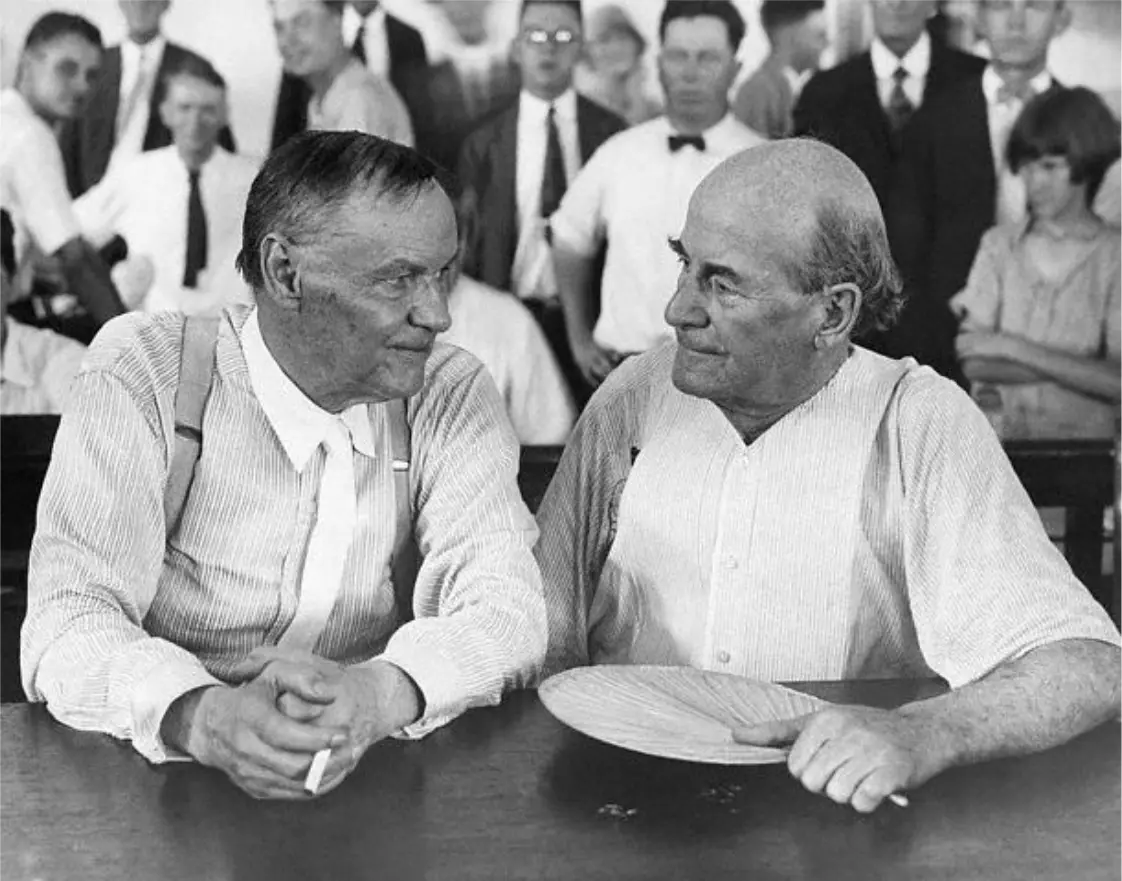
The media bias alone, however, was not the main reason for the huge national interest. The chief factor was the fame of the major players/lead attorneys in the trial. These were no lightweights! The defense attorney who volunteered for the ACLU was Clarence Darrow, a famous and immensely successful trial lawyer. He specialized in representing unpopular defendants and often won seemingly impossible cases. 6 He was also a self-described skeptic and agnostic who had previously tried to arrange a debate with William Jennings Bryan (the prosecuting attorney) about science and religion. 4 The Scopes trial finally gave him that opportunity. In his autobiography, Scopes explains his purpose for participating in the trial, “My object and my only object was to focus the attention of the country on the program of Mr. Bryan and the other Fundamentalists in America.” 6
The prosecuting attorney was Willaim Jennings Bryan, a very popular politician who had run for president three times on the Democratic ticket and had been Secretary of State under Woodrow Wilson. Today he would be an anomaly because his political views were very liberal, supporting, for instance, the radical redistribution of wealth,2 but he was, nonetheless, a conservative Christian. Lest we judge him based on today’s standards, it should be remembered that the full harmful fruits of socialist/communist ideologies had not become evident at that point in history, and Christians were still working through where to stand politically with such philosophies. From Bryan’s perspective at the time, it could be argued that his high view of man created in the image of God led him to desire the alleviation of poverty and suffering and thus an affinity for some socialistic, “utopian” ideas. In spite of his political leanings, Bryan was outspoken about his Fundamentalist faith and his opposition to evolution. He was arguably one of the most famous men in America. Bryan also volunteered his time at the trial, and there is no reason to doubt his motives. He wanted to defend the Bible and the Chrisitan faith against the lies of evolution. With these two “heavyweights” as the lead attorneys, the trial transformed from a “nothing burger” in a tiny southern town to a titanic struggle that everyone wanted to follow. It was the trial of the (twentieth) century! The battle lines had been drawn!
Image
A Legal Skirmish
Ironically enough, the actual legal question of whether John Scopes had violated the “Butler Act” was only a minor skirmish in this monumental battle. Very little time or attention was spent on this point at the trial. In the end, he was found guilty and was charged a $100 fine (which the ACLU paid for him), but if ever there was a case of one side “winning the battle but losing the war” such was the case for creationists with the Scopes trial. Coincidentally enough, 2025 is another “big anniversary” of a classic example of literally “winning a battle but losing the war,” the Battle of Bunker Hill in the American Revolution, fought exactly 250 years ago on June 17, 1775. The British technically held the field on the high ground of Bunker/Breed’s Hill on the outskirts of Boston at the end of the day and “won” the battle after the Continental Army ran out of ammunition, but the “victory” was very hollow. The British lost far more men than the Americans (including about one hundred of their officers killed or injured), 7 and it motivated and encouraged the Americans who had sustained less than half the number of causalities though being outmanned by almost two to one by the most formidable military on the planet! Colonial general Nathanael Greene famously quipped, “I wish we could sell them another hill at the same price.” 7 Likewise, the “win” for the creationists in 1925 was hollow as the long-term consequences were all positive for the evolutionists. It could be argued that the “Creationist Revival” of the 1920s was stopped dead in its tracks. The real battle, that the creationists lost, was in another court, the court of public opinion.
A (Pseudo)Scientific Assault
Darrow and the ACLU were unconcerned about winning the legal skirmish. This was made evident when Darrow eventually had his client plead guilty, which enabled an appeal to higher courts and is what they wanted in the first place. The real battle was not forensic but scientific, and the goal was to make creationists look “anti-science.” I would argue it was actually the evolutionists of the day who were “pseudoscientific” in that all of the “evidences” they were prepared to use have now been proven false and many of them were fraudulent from the beginning. Darrow actually had nine “scientific experts” prepared to testify that “science” overwhelmingly supported biological evolution and millions of years. He also had four “religious experts” prepared to testify that the Genesis account should not be interpreted as literal history. 4 After two days of debate, however, the judge decided to exclude this testimony from the “experts” since it was irrelevant to the legal question. Therefore, the jurors never heard this testimony, but the judge did allow the written statements to be entered into the court record so it could be included in any potential appeal. 4
It is fascinating to look today at the supposed “expert evidence” for evolution in 1925! Some of the “evidences” cited by the experts, and included in Hunter’s Civic Biology textbook that Scopes had allegedly taught from, include the “recapitulation theory” of embryonic development, “missing-link” fossils such as Piltdown man and Java Man, vestigial organs, and the now-discredited “horse evolution” series. All of these have been proven false or fraudulent in modern times. The “recapitulation theory” was popularized by prominent German evolutionist Ernst Haeckel who used fraudulent drawings to claim that the human embryo goes through stages of its “evolutionary history” as it grows (“ontogeny recapitulates phylogeny”). 8 Today even evolutionists admit that the drawings were fake and that this “evidence” is illegitimate.
A “missing-link/hominin” fossil referenced at the trial was Piltdown Man. This was nothing more than a deliberate hoax. Someone took the jaw of an ape, filed the teeth down to resemble those of a human, added a human skull, chemically treated them to give the appearance of age, and then buried it in a gravel pit where it was discovered by a team of anthropologists. This fooled the world’s leading “experts” for forty-one years before being exposed as fraudulent! Java Man was nothing more than a human leg bone and the skull cap of an ape that were found about one year and fifty feet apart on the island of Java. 9 Yet another “hominin fossil” that was not used as evidence in the trial but was widely used “evidence” for evolution at the time was “Nebraska Man.” It was possibly named thus because Williams Jennings Bryan was from Nebraska, and he had begun speaking out against evolution in the 1920s right before the “discovery” of this hominin. 2 Nebraska Man was constructed from a single tooth! From this single tooth, pictures were drawn of an ape-man, family and all. The thirteenth edition of the Encyclopedia Britannica recognized it as a legitimate human fossil. 10 Further study revealed that the tooth came from an extinct pig!
Image
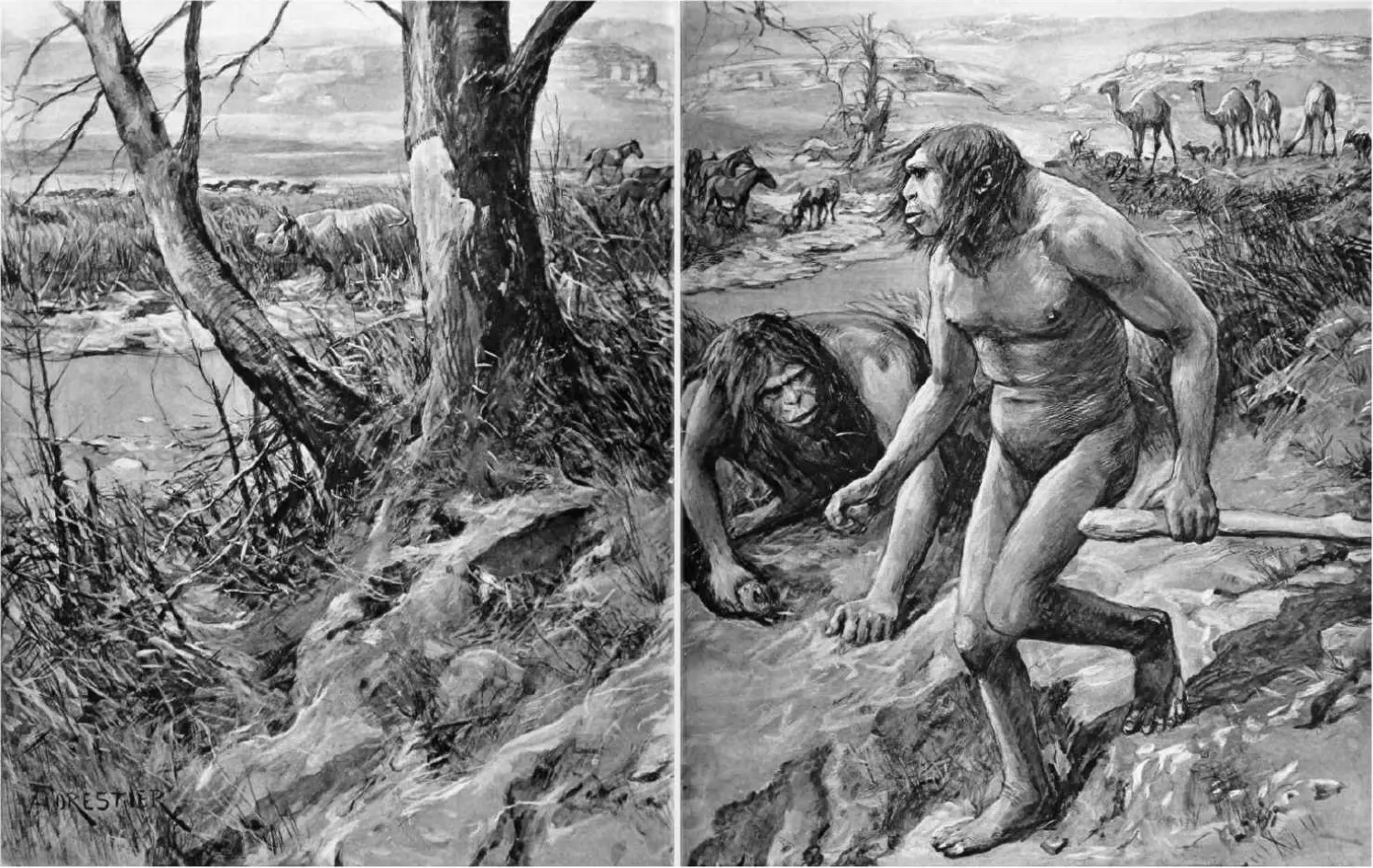
Vestigial organs were another line of evidence cited. Human organs such as the appendix, tailbone, wisdom teeth and others were taught to be useless “evolutionary leftovers” that served no practical function. Today, however, we know that all of these organs serve important functions for our bodies, though it is possible to live without some of them. Even the so-called “junk DNA” argument that was cited by evolutionists of a later generation at the molecular level has now been proven false by modern science. The “horse-series” of evolution was their best example of evolution at the time. However, the horse series is not a series at all. Scientists find different “fossil horses” mixed throughout many different layers of geologic “time.” The first animal in the series, Eohippus, is so different from the modern horse and so different from the next one in the series that there is a big question concerning its right to a place in the series anyway. 11 Furthermore, in the fossil record the rib count, vertebrae count, tooth count, toe count, and the size of the “horses” varies widely and does not show any direct line of progression. Even today, many different varieties of horses live simultaneously. There is simply no progression.
Thus, we can see clearly today that their “science” promoting evolution was not based on objective empirical evidence but on biased, subjective overreaches trying to prove the presuppositions they had already settled on. Even today we must remember the science doesn’t “say” anything, scientists do!
The Strategic Blunders
If the fame of the major players was the reason for the immense interest in the trial in the day, the chief reason for its persistent historical significance was likely the strategic and tactical blunders committed by William Jennings Bryan. There were at least two. First, was his “pseudo-biblical” position that essentially was indefensible, especially when sparring with a man like Darrow.” 2 Rather than holding to a logically consistent position that held to the biblical account as his final authority, Bryan accepted what might be described as “geological evolution” and an ancient age for the earth based on the opinions of secular geologists of the day. Thus, it was a compromise position that was full of logical inconsistencies that Darrow would be able to expose. The second blunder was to agree to Darrow’s outrageous and unprecedented challenge for Bryan to take the witness stand himself as an expert on the Bible with an agreement that Darrow would in turn take the stand and allow Bryan to question him on his agnostic and evolutionary views. 12 These two blunders when combined would prove fatal.
Bryan did well at first under oath. Darrow mockingly ridiculed many of the miraculous events depicted in the Bible, but Bryan, to his credit, stood strong and stuck with the clear words of scripture, refusing to deny the literal, historical validity of these events. Unfortunately, however, the tide turned when Darrow began asking a series of questions relating to a literal six-day creation and the age of the earth. When Darrow asked, “Does the statement ‘the morning and the evening were the first day,’ and ‘the morning and the evening were the second day’ mean anything to you?” Bryan replied, “I do not see that there is any necessity for constructing the words, ‘the evening and the morning’ as meaning necessarily a 24-hour day.” 12 At this point, the war was lost! Darrow went on to pepper Bryan with other questions that he couldn’t answer coherently such as “Where did Cain get his wife?” This question may seem overly esoteric, yet it has been one of the most asked questions over the years to creationists because the question was made famous in Inherit the Wind. 13 The question actually has an easy answer that is obvious today to any informed creationist. Briefly stated, he married his sister. 14 What did that question have to do with the trial? Technically nothing if the “legal skirmish” was merely in view, but if the assault on Christianity and the Bible were in view, the question was hugely significant! Darrow had “won” the day with this line of questioning because he had gotten Bryan, in front of a world-wide audience, to admit that he couldn’t defend the Bible’s history and could/would not interpret the Bible literally as written! Bryan surrendered the reformation doctrine of the “perspicuity of scripture” on the witness stand and caused many to question the Genesis account, which led inevitably (as Genesis is foundational to the rest of scripture) to questioning the rest of the Bible. If one cannot trust the Bible in Genesis 1–11, on what logical basis should they trust it at John 3:16? In the end, Bryan was never able to turn the tables and question Darrow because when that time came, Darrow simply stated that his client wanted to plead guilty, and that was that. The trial was over, and Bryan and creationists had gained a pyrrhic victory at the expense of looking like ignorant buffoons and more importantly at the expense of the reputation and glory of God!
The Subsequent Blowback
“Reaping the whirlwind” in Hosea 8:7 implies a strong “blowback,” and that is exactly what has happened over the last one hundred years in the realms of both science and society. In the realm of science, creationists were never really taken seriously since, and it became common to simply “marginalize” creationist ideas into the category of “religion” and never given serious consideration. Thus, the theory of evolution had no competition in the scientific establishment, and we have endured one hundred years of “monkey business” scientifically with “evidence” after “evidence” being presented as the latest and greatest proof of evolution, only to inevitably be proven false in the long run. Bryan had been prepared in his closing argument to show that evolution had not been and could not be scientifically proven. Unfortunately, he never got to deliver his closing remarks, and he died five days after the trial. However, the remarks he was prepared to give were subsequently published. He states,
Christians know that “the fear of the Lord is the beginning of wisdom” now just as it has been in the past, and they therefore oppose the teaching of guesses that encourage godliness among the students…. Evolution is not truth; it is merely an [sic] hypothesis—it is millions of guesses strung together. It had not been proved in the days of Darwin…. It had not been proved in the days of Huxley, and it has not been proved up to today. 15
In the realm of society, the Bible’s morality began to crumble. Quoting Terry Mortenson of Answer in Genesis:
Today’s American culture has eroded much further since the disaster of the Scopes trial. Belief that humans evolved over millions of years undermines biblical authority and morality, resulting in a culture of increased heterosexual immorality, homosexuality, transgenderism, abortion, euthanasia, and assisted suicide. But if we’re just animals with no accountability to God, then there is no basis to say any of those things is wrong. 4
We have also seen a mass exodus from the church in recent years and a growing rejection of the gospel and the Christian faith. This was inevitable as a rejection of the plain words of scripture regarding history necessarily lead to a rejection of biblical morality and biblical doctrine!
Concluding Thoughts
There are two key take-aways that creationists can glean from Scopes after one hundred years of hindsight. For one, we should learn to trust the Bible even when we don’t immediately have all the answers for critics. Bryan failed here, specifically when it came to the age of the earth, though it is difficult to be overly critical in light of the historical context. What would we have done if we were in his shoes? We have to remember that in his day there was no young-earth creationist movement! Even the “Fundamentalists” of the day had succumbed to belief in millions of years. The famous Scofield Reference Bible, for instance, the Bible of “Fundamentalism,” had notes about the Gap Theory. The famous and highly influential series of essays entitled “The Fundamentals” published between 1910 and 1915 to combat modernism, all written by “inerrantists,” contained articles about evolution that were all compromised by the acceptance of deep- time/millions of years. 16 Practically the only Christians still standing publicly for a literal six-day creation at the time, were Seventh Day Adventists—they had to if they were to be consistent with their views on the literal seventh day of creation—such as self-taught geologist Geroge McCready Price, who actually had warned Bryan against his compromising strategy. 17 For the record, I disagree vehemently with much of Adventist theology, but I give them credit where credit is due on this point. Thus, Bryan would have been standing virtually alone had he stood for a young-earth creation in 1925. However, history would have vindicated him beginning in 1961 with the publication of The Genesis Flood by John Whitcomb and Henry Morris that initiated the modern young-earth creation movement that began to give answers/evidence pointing to a young earth and recent creation. Just as it always does, whether in the realm of science, archaeology, fulfilled prophecy, or whatever, the Bible proved true and reliable in the long run!
The second major takeaway is the danger of compromise. Bryan likely thought that it would help the Christian cause by looking more “scientific” in accepting deep-time/millions of years. He failed to realize though how the veracity and authority of the rest of the Bible is tied to the veracity and authority of Genesis. When the foundation collapses the rest of the structure (the Bible) collapses with it. He also failed to realize the damaging theological implications to the gospel message that comes from the concepts of millions of years and “death before sin,” that is inherently tied to it. Under such a system, death cannot be the penalty for sin since it was around for millions of years before sin, making Christ’s death meaningless!
Perhaps Bryan argued to himself, as so many “old-earth creationists” do today, that arguing for a young earth and a literal six-day creation might keep people from accepting the gospel and coming to Christ. That would be just too big of a stumbling block! Why make the gospel harder to believe? We need to make it as palatable as possible! After all, one does not have to be correct on the age of the earth to be saved, one merely has to repent of sin and trust Christ as Lord and Savior! To show the danger of this line of thinking and to conclude my thoughts, let me quote from an earlier article I wrote for TASC some years ago:
Those committed to an “Evidential” or “Classical” philosophy of apologetics might be tempted to find some sort of “neutral ground” when arguing for the validity of Creation, the Bible, and the Christian faith. When this is done, one inevitably has to accept some of the presuppositions of one’s opponent in the debate. Though that would obviously not include full-blown Darwinian evolution, in the modern world it might include presuppositions relating to an ancient age of the earth that are pretty much undebatable “givens” in secular circles today. …
Unfortunately, however, this strategy of modifying existing worldviews is very ineffective in that the Christian faith, and evidence used to validate it, never fits neatly into a secular worldview. For instance, where do you put dinosaurs in the approximately 6000 years of Biblical history if you start from a secular worldview? Inevitably, one will have to find a way to “pigeonhole” millions of years into the Biblical text in order to make dinosaurs fit the secular timeline that is taken from a secular worldview. In contrast, if an ancient earth is not assumed, then dinosaurs could have easily lived with man when created on Day 6 of the creation account without the necessity of redefining the plain meaning of the word “day” (yom) and/or doing the mental gymnastics necessary to account for “death before sin” (note Romans 5:12) that is required to reconcile millions of years with Genesis. Thus, a presuppositional philosophy that assumes a totally Biblical worldview gives a more believable scientific explanation than an evidential philosophy that does not. This statement would likely be disputed by old-earth creationists as absurd since the idea of an ancient earth seems much more “believable” in our present world than the idea of a young one, but that is only because they have already accepted the presuppositions (i.e., millions of years) of the prevailing evolutionary paradigm. If one throws out the prevailing paradigm entirely, then a young-earth creation model seems to be more consistent, at least in the author’s opinion, with the straight-forward Biblical text and the scientific evidence than does an old-earth model. (It is important to note that there are no dating methods that give “old-earth” ages that do not begin with old-earth presuppositions and assumptions. 18 ) 19
Thus, we are far better off to present evidence within a framework that seems radically new and different to the recipient than to try to force it into an existing secular worldview where it does not “fit” consistently. Granted, switching from one worldview to another is a radical leap, but does not the gospel itself demand a radical leap of repentant faith of those who would accept it? Also, we should consider the biblically clear teaching that no one can be “argued into the kingdom of God” and that only those whose blinded eyes are opened and are drawn to Christ by the Father will ever repent and believe in the first place (John 6:44, II Corinthians 4:4–6). Too many evangelicals today seem to think that palatability of the message is the most important factor in evangelism, but could it be that consistency of the message is actually the key to seeing true conversions rather than mere professions? A biblical gospel must be coupled with a biblical worldview or it loses its power (Romans 1:16)!
- 1Jeanson NT (2025 Jul 21) The surprising effects of the Scopes trial-100 years later. https://answersingenesis.org/scopes-trial/effects-scopes-trial-100-years-later/ Accessed 2025 Aug 08
- 2 a b c Carter R (2020 Aug 25) Scopes at 100. https://creation.com/scopes-at-100 Accessed 2025 Aug 08
- 3Ham K, Menton D (2008) Why is the Scopes trial significant, The New Answers Book 2, Master Books, Green Forest, AR, 279
- 4 a b c d e Mortenson T (2025 Jul 18) The 1925 Scopes evolution trial: Why it matters 100 years later. https://christoverall.com/article/concise/the-1925-scopes-evolution-trial-why-it-matters-100-years-later/ Accessed 2025 Aug 08
- 5 a b Morris HM (1993) History of Modern Creationism, Institute for Creation Research, Santee, CA, 70
- 6 a b Ham K, Menton D (2008) 280
- 7 a b Farnam Street Media, Pyrrhic victory: Winning the battle, losing the war, https://fs.blog/winning-battle-losing-war/ Accessed 2025 Aug 08
- 8Sarfati J (1999) Refuting Evolution, Master Books, Green Forest, AR, 85–87
- 9Creation Question (1991 Jun) Who was ‘Java man’?, Creation 13(3): 22–23, https://creation.com/who-was-java-man Accessed 2025 Aug 08
- 10Mulfinger G (1975) The Flood & the Fossils, Bob Jones University Press, Greenville, SC, 12
- 11Sarfati J (2002) Refuting Evolution 2, Master Books, Green Forest, AR, 133
- 12 a b Ham K, Menton D (2008) 281
- 13Ham K (2000 Sep 11) Still the most asked question…”Where Did Cain Get His Wife?”, https://answersingenesis.org/bible-characters/cain/still-the-most-asked-question/ Accessed 2025 Aug 14
- 14See Ham K (2006) Cain’s wife—Who was she?, The New Answers Book, Master Books Green Forest, AR, 64–76 for a more detailed answer that includes scientific implications.
- 15Mueller M (2025 Jun 20) The Scopes Monkey Trial: A battle of worldviews, Acts & Facts (July/August 2025) 21. The full transcript of Bryan’s closing remarks can be found at https://archive.org/stream/cain-2009-william-jennings-bryan-last-message-9781906267162/Cain-2009-William-Jennings-Bryan-Last-Message-9781906267162_djvu.txt.
- 16Torrey RL, Feinberg CL (1990) The Fundamentals: The Famous Sourcebook of Foundational Biblical Truths, Kregel Publications, Grand Rapids, MI.
- 17Morris HM (1993) 73
- 18Greear D (2021 Aug) Boiled-out or baked-in?, https://tasc-creationscience.org/sites/default/files/2021-07/aug2021.pdf
- 19Greear D (2017 Apr) The role of presuppositions and worldviews in the creation-evolution debate, 3. https://tasc-creationscience.org/sites/default/files/2019-07/apr2017_0.pdf